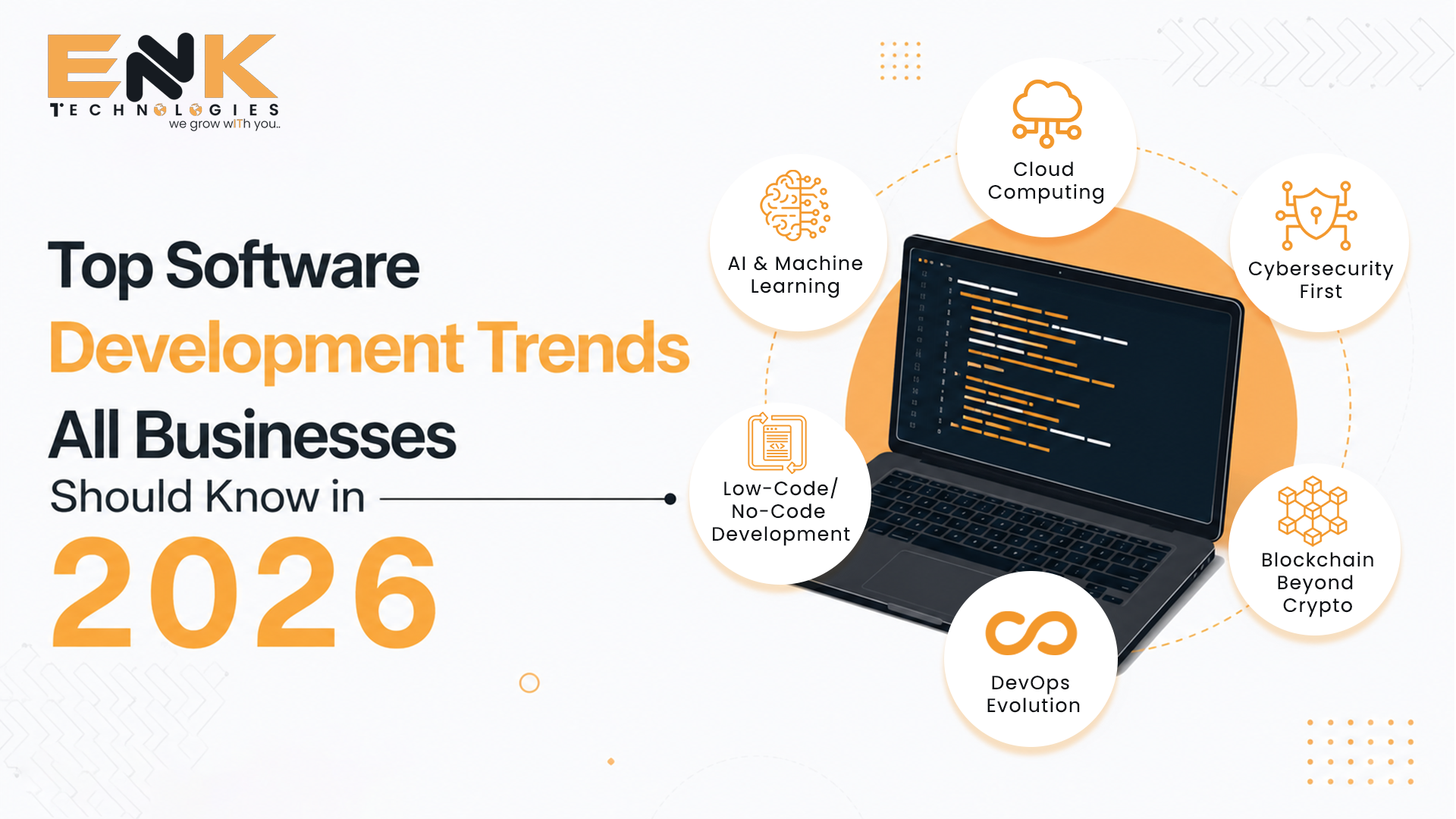
Software development is changing more quickly than ever as companies continue to embrace digital transformation. In order to enhance customer experiences, optimize operations, and maintain a competitive edge, businesses are investing in more intelligent, quicker, and secure software solutions in 2026.
Understanding the latest and most current trends in software development may help you make smart technical choices and improve your return on investment, no matter your startup, small-scale business, or enterprise. ENK technology assists companies in implementing modern technology to create software solutions that are secure, scalable, and ready for the future.
Let's explore the most popular trends in software development:
1. The Impact of Artificial Intelligence (AI) in Business is Increasing
- ● Common AI Applications
- ● Creating responsive layouts
- ● Customer support automation
- ● Predictive analytics
- ● Intelligent recommendation systems
- ● Fraud detection
- ● Document processing
- ● Workflow automation
- ● Business Benefits
- ● Faster customer service
- ● Reduced operational costs
- ● Improved productivity
- ● Better business insights
- ● Enhanced user experiences
2. Low-Code and No-Code Development Continues to Grow
Companies are searching for faster approaches to develop applications without increasing development costs. Businesses can develop internal apps, manage processes, and offer digital solutions much faster and more efficiently with low-code and no-code platforms.
Benefits
- ● Faster project delivery
- ● Lower development costs
- ● Rapid prototyping
- ● Increased business agility
3. Cybersecurity is a Top Priority
Cyber threats continue to increase, making software security more important than ever. Businesses are now adopting Secure Software Development Lifecycle (SSDLC) practices to build security into applications from the beginning instead of treating it as an afterthought.
Key Security Practices
- ● Multi-factor authentication
- ● Data encryption
- ● Secure APIs
- ● Regular vulnerability testing
- ● Role-based access control
- ● Security audits
- ● Compliance management
4. Cloud-Native Development is the New Standard
More organizations are migrating to cloud infrastructure to improve flexibility and reduce operational costs. Cloud-native applications are designed specifically for platforms like AWS, Microsoft Azure, and Google Cloud, allowing businesses to scale quickly and maintain high availability.
Advantages
- ● Better scalability
- ● Faster deployments
- ● Reduced infrastructure costs
- ● High performance
- ● Improved disaster recovery
5. Custom Software is Replacing Generic Solutions
Every company has different clients, objectives, and workflows. Custom solutions give firms a competitive edge that generic software cannot match; off-the-shelf software frequently lacks the flexibility required to support long-term growth. Custom software development allows businesses to create applications tailored to their exact requirements.
- ● Custom Software Benefits
- ● Personalized features
- ● Better integration with existing systems
- ● Improved efficiency
- ● Enhanced security
- ● Long-term scalability
6. API-First Development Improves Connectivity
API-first development enables seamless integration between CRMs, ERPs, payment gateways, mobile apps, cloud platforms, and third-party services.
- ● Business Advantages
- ● Faster integrations
- ● Better scalability
- ● Easier maintenance
- ● Improved customer experiences
- ● Future-ready architecture
7. Progressive Web Applications (PWAs) Continue to Rise
Businesses are increasingly adopting Progressive Web Apps because they combine the advantages of websites and mobile applications. PWAs provide faster loading times, offline functionality, and responsive user experiences without requiring users to download an app.
Benefits
- ● Lower development costs
- ● Cross-platform compatibility
- ● Faster performance
- ● Improved user engagement
- ● Easier maintenance
8. DevOps and CI/CD Speed Up Software Delivery
DevOps, combined with Continuous Integration (CI) and Continuous Deployment (CD), enables development teams to deliver software updates quickly and reliably.
Benefits
- ● Faster deployment cycles
- ● Higher software quality
- ● Better collaboration
- ● Reduced downtime
- ● Improved customer satisfaction
9. Data Analytics Drives Smarter Business Decisions
Modern software applications now include built-in dashboards, reporting tools, and analytics that help businesses monitor performance and make informed decisions.
- ● Business Applications
- ● Sales reporting
- ● Customer behavior analysis
- ● Marketing performance
- ● Inventory tracking
- ● Financial forecasting
User Experience (UX) is a Competitive Advantage
Businesses that prioritize UI/UX design achieve higher customer satisfaction, better engagement, and improved conversion rates.
- ● UX Best Practices
- ● Responsive design
- ● Simple navigation
- ● Fast loading speed
- ● Accessibility compliance
- ● Consistent interfaces